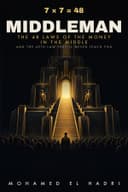
MIDDLEMAN: The Book Behind the 48 Laws of the Money in the Middle

The customer calls him. He calls you. I wrote MIDDLEMAN to show you how to own that first call.
What MIDDLEMAN actually is
MIDDLEMAN is 48 laws, arranged on seven floors of a building, with a 49th floor sealed shut above them. The subtitle is "7 x 7 = 48, The 48 Laws of the Money in the Middle." Seven floors of seven laws is forty-nine. The book gives you forty-eight and locks the last one. That is not a typo. It is the whole point.
First you learn to see who takes the cut. Then you learn to own the customer, hold the relationship and make going around you a worse deal. Later floors cover systems, choosing your market and owning the platforms other middlemen depend on.
Sell your hours and you build someone else's life. Buy hours and you build your own.
That's the engine under every single law in the book. The man who sells his hands is capped by his own two hands. The man who owns the doorway isn't.
Why 7 x 7 = 48, and not 49
I left the maths wrong on purpose. Seven floors, seven laws each, should give you forty-nine laws. MIDDLEMAN gives you forty-eight and keeps one behind a locked door.
The 49th law is inheritance. The chair, not the tools. I take that law into its own book: The Family Secret. Join the launch list to hear when the book is live.
The seven floors, in order
Here's the climb, floor by floor:
- The Eyes (Laws 1-7) - learning to see the middlemen already standing in every transaction around you.
- The Position (Laws 8-14) - taking the spot between two sides and controlling what passes through it.
- The Grip (Laws 15-21) - owning the customer and making yourself impossible to go around.
- The Moat (Laws 22-28) - building walls a competitor can't cross: complexity, time, a network.
- The Climb (Laws 29-35) - turning one good deal into a machine that runs without your hands.
- The Choice (Laws 36-42) - picking the floor that decides everything, before you work hard on it.
- The Penthouse (Laws 43-48) - dropping the shame, refusing to die on the floor you were born on, and reaching the locked door of the 49th.
Floor one exists because you can't stand in a doorway you haven't learned to see. Floor three exists because a position you can be removed from is not a position, it's a favour someone is doing you until they change their mind. Floor seven still gives you moves to make: middleman the middlemen, win the customer in a service trade without doing the work yourself, and become the name people call. It also asks you to drop the shame you were taught to feel about standing in the middle in the first place, and to refuse to die on the floor you were born on.
Read the 48 laws before you buy anything. See what each floor teaches, then decide if you want to climb it.
Who I wrote it for
I wrote MIDDLEMAN for the person on the ground floor - the tradesperson, the driver, the freelancer, the one selling hours because nobody ever showed him another way to get paid. Law 1 opens with the thing everyone owns and nobody made themselves: pick up your phone, your cup, your shoe. Someone stood in the middle of every single one of those objects and took a slice on the way past. The whole book is the argument that the slice can be yours instead.
It is not written for someone chasing a get-rich-overnight fantasy. There's no product to flip, no coin to buy, no course upsell hidden in chapter twelve. It's a way of seeing, applied law by law until you can walk into any market and spot the good floor in the wild on your own, without me.
If you already run a business that owns its customer, keeps its margin invisible, and never lets the two sides shake hands without you, you probably don't need this book. Use the laws to test your position instead: can the customer go around you? Does the work stop when you step away?
I also wrote MIDDLEMAN for you if you already stand in the middle and don't know it yet. The recruiter who calls it "recruiting" instead of standing between an employer and a candidate. The agent who calls it "agency" instead of controlling what passes between two sides who'd otherwise never find each other. Same position, different name, same 48 laws underneath it. The book just gives the position its real name.
I'm Mohamed El Hadri, also @mointhemarket. If the name's new to you, that's where to find more of the same thinking before you spend $7 on the book.
What you get for $7
MIDDLEMAN is a $7 instant download: PDF and ePub, both in the same purchase, through Stripe checkout at /middleman. No shipping, no waiting, no subscription hiding behind the price. You pay once and it's yours to read on whatever you already read on.
Before you spend $7, the first floor is free by email. Seven laws, no card required. Read them, then decide whether you want the other forty-one.
Where to go next
Read how to become a middleman for the first move: find the gap, own the customer, defend your position. It's the map. Then use MIDDLEMAN to examine what holds that position together: the customer relationship, the guarantee, the suppliers and the systems.
If you'd rather listen than read, and you want the money mechanics of a real building business laid out chapter by chapter, THE EDGE is a listening book on ElevenReader, first chapters free.
And if you're wondering what sits behind that sealed 49th floor, the manuscript is already finished. The Family Secret is going to print. Join the launch list to hear when the book is live.
Get MIDDLEMAN for $7. PDF and ePub, both in one purchase. Start climbing.
Want the whole staircase?
Three books by Mohamed El Hadri. Start anywhere. Climb in order.